Initially, I wasn’t going to do a book recommendations post highlighting the 250th birthday of the United States’ independence because, let’s be honest, celebrating this milestone did not put me in a happy mood. With everything going on and the country looking like it is heading towards a downfall, celebrating 250 years just left a bad taste in my mouth.
But as I was thinking about it about all the chaos and mayhem that has happened just in the past year, I realized that even after 250 years, our country still has a lot of work to do. We cannot just celebrate our past but also learn from it, understand it better, and have an open discussion about it, warts and all. We can’t achieve a better future if we don’t learn from our past, and honestly, I believe that is why we are where we are today.
Our history is complex and that’s ok. So, if you are looking to understand and read more about the history of the United States, the good and the bad, check out these recommendations that will allow you to ask questions and have a deeper perspective:

A Resistance History of the United States by Tad Stoermer
The United States was shaped by resistance—but not in the way we’ve been taught. The Revolution did not secure liberty; it opened the door to either liberty or oppression, where only white men enjoyed all of the benefits and protections of citizenship.
In A Resistance History of the United States, public historian Tad Stoermer shows how from the very beginning, that tension—between the ideals of resistance and the realities of power—has defined America more than the Enlightenment ideals enshrined in the Declaration of Independence and the Constitution.
Utililizing powerful storytelling to focus on key—and often lesser-known—moments in American history, this book reveals the truth of how resistance movements from Colonial times have opposed the powers that be. Stoermer covers an impressive roster of pivotal movements, with each chapter identifying a key resistance movement and principle meant to inspire contemporary readers, including:
- Bacon’s Rebellion/Metacomet’s War (1676)
- Salem Witch Trials (1692)
- The Black Loyalists (1783)
- The Underground Railroad (1850)
Through these and many more examples, Stoermer dismantles the mythologies that pass for American history—exposing the curated nostalgia, moral evasions, and institutional silences that have long protected abusive power. What emerges is an essential look at how we can take lessons from the past to understand, and effectively respond to, the injustices we face today. (Credit: Steerforth)

An Indigenous Peoples’ History of the United States by Roxanne Dunbar-Ortiz
The first history of the United States told from the perspective of indigenous peoples
Today in the United States, there are more than five hundred federally recognized Indigenous nations comprising nearly three million people, descendants of the fifteen million Native people who once inhabited this land. The centuries-long genocidal program of the US settler-colonial regimen has largely been omitted from history. Now, for the first time, acclaimed historian and activist Roxanne Dunbar-Ortizoffers a history of the United States told from the perspective of Indigenous peoples and reveals how Native Americans, for centuries, actively resisted expansion of the US empire.
With growing support for movements such as the campaign to abolish Columbus Day and replace it with Indigenous Peoples’ Day and the Dakota Access Pipeline protest led by the Standing Rock Sioux Tribe, An Indigenous Peoples’ History of the United States is an essential resource providing historical threads that are crucial for understanding the present. In An Indigenous Peoples’ History of the United States, Dunbar-Ortiz adroitly challenges the founding myth of the United States and shows how policy against the Indigenous peoples was colonialist and designed to seize the territories of the original inhabitants, displacing or eliminating them. And as Dunbar-Ortiz reveals, this policy was praised in popular culture, through writers like James Fenimore Cooper and Walt Whitman, and in the highest offices of government and the military. Shockingly, as the genocidal policy reached its zenith under President Andrew Jackson, its ruthlessness was best articulated by US Army general Thomas S. Jesup, who, in 1836, wrote of the Seminoles: “The country can be rid of them only by exterminating them.”
Spanning more than four hundred years, this classic bottom-up peoples’ history radically reframes US history and explodes the silences that have haunted our national narrative.(Credit: Beacon Press)

They Called Us Enemy by George Takei, Justin Eisinger and Steven Scott and illustrated by Harmony Becke
George Takei has captured hearts and minds worldwide with his captivating stage presence and outspoken commitment to equal rights. But long before he braved new frontiers in Star Trek, he woke up as a four-year-old boy to find his own birth country at war with his father’s — and their entire family forced from their home into an uncertain future.
In 1942, at the order of President Franklin D. Roosevelt, every person of Japanese descent on the west coast was rounded up and shipped to one of ten “relocation centers,” hundreds or thousands of miles from home, where they would be held for years under armed guard.
They Called Us Enemy is Takei’s firsthand account of those years behind barbed wire, the joys and terrors of growing up under legalized racism, his mother’s hard choices, his father’s faith in democracy, and the way those experiences planted the seeds for his astonishing future.
What does it mean to be American? Who gets to decide? When the world is against you, what can one person do? To answer these questions, George Takei joins co-writers Justin Eisinger & Steven Scott and artist Harmony Becker for the journey of a lifetime. (Credit: Top Shelf Productions)

She Came To Slay: The Life and Times of Harriet Tubman by Erica Armstrong Dunbar
Harriet Tubman is best known as one of the most famous conductors on the Underground Railroad. As a leading abolitionist, her bravery and selflessness has inspired generations in the continuing struggle for civil rights. Now, National Book Award nominee Erica Armstrong Dunbar presents a fresh take on this American icon blending traditional biography, illustrations, photos, and engaging sidebars that illuminate the life of Tubman as never before.
Not only did Tubman help liberate hundreds of slaves, she was the first woman to lead an armed expedition during the Civil War, worked as a spy for the Union Army, was a fierce suffragist, and was an advocate for the aged. She Came to Slay reveals the many complexities and varied accomplishments of one of our nation’s true heroes and offers an accessible and modern interpretation of Tubman’s life that is both informative and engaging.
Filled with rare outtakes of commentary, an expansive timeline of Tubman’s life, photos (both new and those in public domain), commissioned illustrations, and sections including “Harriet By the Numbers” (number of times she went back down south, approximately how many people she rescued, the bounty on her head) and “Harriet’s Homies” (those who supported her over the years), She Came to Slay is a stunning and powerful mix of pop culture and scholarship and proves that Harriet Tubman is well deserving of her permanent place in our nation’s history. (Credit: 37 Ink)

Sí, Se Puede: The Latino Heroes Who Changed the United States by Julio Anta and Yasmín Flores Montañez
From community activism to the halls of government, pop-culture, arts, and beyond, Latinos have shaped every aspect of American life. Nevertheless, these significant figures and their contributions are often left out of our textbooks. Sí, Se Puede, named after the “Yes, We Can” motto of the United Farm Workers, brings Latino history in the U.S. to the forefront.
The book follows a group of Hispanic-Americans as they embark on an interactive museum tour to meet Latino heroes they may not have learned about in school. The high tech, immersive exhibit allows the tour group to virtually travel through time, visiting the Hispanic Union soldiers of the Civil War; marching with César Chávez and Dolores Huerta in the farmworkers struggle; going to space with Ellen Ochoa, the first Latina to leave Earth’s atmosphere; meeting the youngest woman to ever serve in Congress, Alexandria Ocasio-Cortez; and more. This ensemble of unlikely friends discover the rich history of Latinos in the United States, and gain new insights into their own American experiences.
Sí, Se Puede shines a spotlight on the often-overlooked Latino heroes throughout US history, bringing their stories to life through the sequential action, illustrated characters, and lush color palette of a graphic novel. (Credit: Ten Speed Graphic)

Fault Lines in the Constitution: The Framers, Their Fights, and the Flaws that Affect Us Today by Cynthia Levinson and Sanford Levinson
Many of us take certain features in our political system for granted, even when we complain about them. But these fault lines didn’t spontaneously arise—they have their roots in the Constitution itself, the result of disagreements and compromises made by the Framers in 1787—and we’re still feeling the ramifications today.
Fault Lines in the Constitution takes readers back to the creation of this historic document and discusses the original intent and worldview of the Framers, when and how problems arose after the fact, and possible solutions for those problems, inspired by both constitutions of individual US states and other countries. Each chapter begins with a true story that connects directly back to a section of the document that forms the basis of our society and government.
Written by an award-winning middle grade author and a constitutional law scholar, this new edition includes updated content throughout; two new chapters on Impeachment and Secession; significant expansion of the chapters on Emergency Powers and Term Limits; and revisions throughout that reflect political and social changes leading up to and following the 2024 national election. (Credit: Peachtree)

We the People Is All the People by Howard W Reeves and illustrated by Duncan Tonatiuh
We the people of the United States, in order to form a more perfect union . . .
Who are the “we the people” mentioned in the preamble to the U.S. Constitution? They are our neighbors next door, down the street, or across the country. They live in different places, worship in different ways, come from different backgrounds and histories. They struggle, achieve, and overcome. They are you, and me, and us.
Because, as we strive to create a more perfect union, “we” should mean “all.”
This beautiful picture book celebration of the best of America includes the preamble to the United States Constitution as well as notes from the author and artist. (Credit: Abrams Books for Young Readers)

The Watsons Go to Birmingham–1963 by Christopher Paul Curtis
When the Watson family—ten-year-old Kenny, Momma, Dad, little sister Joetta, and brother Byron—sets out on a trip south to visit Grandma in Birmingham, Alabama, they don’t realize that they’re heading toward one of the darkest moments in America’s history. The Watsons’ journey reminds us that even in the hardest times, laughter and family can help us get through anything. (Credit: Yearling)

The Fight of Our Lives: AIDS in America by David Levithan and Gabriel Duckels
The AIDS crisis in America is complex and composed of countless individual stories of grief, love, and advocacy. Its history shows the power of youth activism, how creativity and community can be vehicles for social change, and how bigotry and misinformation led to inequality in care.
The early days of the AIDS crisis saw LGBTQ+ and other marginalized communities making strides in the fight for equality. As many people in positions of power were slow to act or actively didn’t pay attention until their own communities were affected, the fight for equality turned into a fight for their lives. Grassroots efforts filled in gaps where mainstream medicine and politics failed, and over time, a cultural shift of awareness emerged, which led to more research and more treatments. And while the disease has transitioned from a death sentence to one that people can live full lives with, there are still people dying of HIV/AIDS today because they can’t access the care they need. The fight may have begun decades ago, but is not yet over.
Award-winning author David Levithan and University of Cambridge PhD Gabriel Duckels detail a brief history of the epidemic, touching on key moments and figures, such as Ryan White, ACT UP, Larry Kramer and Anthony Fauci, Pedro Zamora from MTV’s The Real World, and the Names Quilt. Threaded throughout are poems, essays, and other creative works, in addition to first-person interviews and narratives. The most important takeaway is that we must remember. We need to know what happened and why. Our voices are powerful, and they can make a difference. (Credit: Knopf Books for Young Readers)
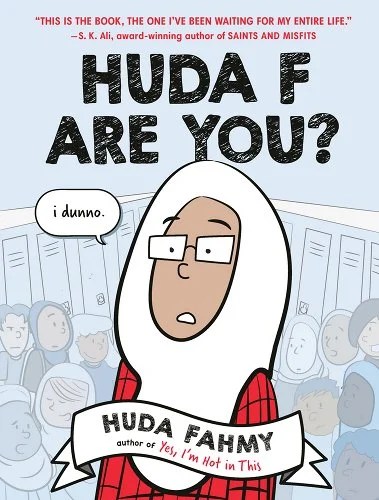
Huda F Are You? by Huda Fahmy
Huda and her family just moved to Dearborn, Michigan, a small town with a big Muslim population. In her old town, Huda knew exactly who she was: She was the hijabi girl. But in Dearborn, everyone is the hijabi girl.
Huda is lost in a sea of hijabis, and she can’t rely on her hijab to define her anymore. She has to define herself. So she tries on a bunch of cliques, but she isn’t a hijabi fashionista or a hijabi athlete or a hijabi gamer. She’s not the one who knows everything about her religion or the one all the guys like. She’s miscellaneous, which makes her feel like no one at all. Until she realizes that it’ll take finding out who she isn’t to figure out who she is. (Credit: Dial Books)

Can’t Stop Won’t Stop: A History of the Hip-Hop Generation by Jeff Chang
Forged in the fires of the Bronx and Kingston, Jamaica, hip-hop became the Esperanto of youth rebellion and a generation-defining movement. In a post-civil rights era defined by deindustrialization and globalization, hip-hop crystallized a multiracial, polycultural generation’s worldview, and transformed American politics and culture. But that epic story has never been told with this kind of breadth, insight, and style.
Based on original interviews with DJs, b-boys, rappers, graffiti writers, activists, and gang members, with unforgettable portraits of many of hip-hop’s forebears, founders, and mavericks, including DJ Kool Herc, Afrika Bambaataa, Chuck D, and Ice Cube, Can’t Stop Won’t Stop chronicles the events, the ideas, the music, and the art that marked the hip-hop generation’s rise from the ashes of the 60’s into the new millennium. (Credit: Picador)

A Queer History of the United States by Michael Bronski
In this new edition of A Queer History of the United States, Michael Bronski’s classic book now covers 500 years, bringing queer history into the 21st century and further illuminates how profoundly the LGBTQ+ life and people have shaped America.
Drawing upon primary documents, literature, and popular culture, Bronski weaves a comprehensive tapestry of LGBTQ+ history, providing startling examples of unknown or ignored aspects of our collective past.
From the ineffectiveness of sodomy laws in the colonies, to how rock music and youth culture unintentionally engendered the devastating backlash against gay rights in the late 1970s; from individuals such as Robert Treat Paine and Ezekiel Dodge, Harvard classmates in 1774 who formed a deep, loving relationship and wrote passionate love letters to one another to Lucy Hicks Andersen, a married African American socialite and celebrity chef in Oxnard, California, whose story appeared in Time magazine in 1945 after her transgender identity became known, Bronski covers an eclectic breadth of facts and stories.
This revised edition includes details on the evolution of the transgender liberation movement, the upsurge of vibrant queer movements of color, the groundbreaking emergence of new sexual and gender identities, and concludes by analyzing the current conservative backlash against LGBTQ rights, racial and social justice policies, and the drive to eradicate historical diversity.
Not simply about “gay history” it is about all American history, Bronski’s dynamic and revealing narrative radically reframes how we understand our past and, more important, our present. (Credit: Beacon Press)

The Hate U Give by Angie Thomas
Sixteen-year-old Starr Carter moves between two worlds: the poor neighborhood where she lives and the fancy suburban prep school she attends. The uneasy balance between these worlds is shattered when Starr witnesses the fatal shooting of her childhood best friend Khalil at the hands of a police officer. Khalil was unarmed.
Soon afterward, his death is a national headline. Some are calling him a thug, maybe even a drug dealer and a gangbanger. Protesters are taking to the streets in Khalil’s name. Some cops and the local drug lord try to intimidate Starr and her family. What everyone wants to know is: what really went down that night? And the only person alive who can answer that is Starr.
But what Starr does—or does not—say could upend her community. It could also endanger her life. (Credit: Clarion Books)

March: The Complete Trilogy by John Lewis, Andrew Aydin and Nate Powell
Congressman John Lewis (GA-5) was an American icon who repeatedly made history as one of the key figures of the Civil Rights Movement. His commitment to justice and nonviolence brought him from an Alabama sharecropper’s farm to the halls of Congress, from a segregated schoolroom to the 1963 March on Washington, and from receiving beatings from state troopers to receiving the Medal of Freedom from the first African-American president.
To share his remarkable story with new generations, Lewis turned to the graphic novel format, in collaboration with co-writer Andrew Aydin and artist Nate Powell, and inspired by a 1950s comic book that helped prepare his own generation to join the struggle. The resulting trilogy, March, became a groundbreaking and definitive work of graphic memoir — a perennial bestseller, a vital resource in classrooms across America, the recipient of countless honors, and the first comic to win the National Book Award. Today, March continues to animate the lessons of history with vivid life for new generations, powerfully and urgently relevant for our world. It is a vivid first-hand account of John Lewis’ lifelong struggle for civil and human rights, meditating in the modern age on the distance traveled since the days of Jim Crow and segregation. Rooted in Lewis’ personal story, it also reflects on the highs and lows of the broader Civil Rights Movement, with a particular focus on young adults. Through an unforgettable literary and artistic narrative, March portrays the surpassing courage, sacrifice, and revolutionary nonviolence that transformed American society in the 1960s, guided by principles and tactics that remain vitally relevant in the present day. (Credit: Top Shelf Productions)

War Against All Puerto Ricans: Revolution and Terror in America’s Colony by Nelson A Denis
In 1950, after over fifty years of military occupation and colonial rule, the Nationalist Party of Puerto Rico staged an unsuccessful armed insurrection against the United States. Violence swept through the island: assassins were sent to kill President Harry Truman, gunfights roared in eight towns, police stations and post offices were burned down. In order to suppress this uprising, the US Army deployed thousands of troops and bombarded two towns, marking the first time in history that the US government bombed its own citizens.
Nelson A. Denis tells this powerful story through the controversial life of Pedro Albizu Campos, who served as the president of the Nationalist Party. A lawyer, chemical engineer, and the first Puerto Rican to graduate from Harvard Law School, Albizu Campos was imprisoned for twenty-five years and died under mysterious circumstances. By tracing his life and death, Denis shows how the journey of Albizu Campos is part of a larger story of Puerto Rico and US colonialism.
Through oral histories, personal interviews, eyewitness accounts, congressional testimony, and recently declassified FBI files, War Against All Puerto Ricans tells the story of a forgotten revolution and its context in Puerto Rico’s history, from the US invasion in 1898 to the modern-day struggle for self-determination. Denis provides an unflinching account of the gunfights, prison riots, political intrigue, FBI and CIA covert activity, and mass hysteria that accompanied this tumultuous period in Puerto Rican history. (Credit: Bold Type Books)

Bury My Heart at Wounded Knee: An Indian History of the American West by Dee Brown
First published in 1970, Bury My Heart at Wounded Knee is Dee Brown’s eloquent, meticulously documented account of the systematic destruction of American Indians during the second half of the nineteenth century. A national bestseller in hardcover for more than a year after its initial publication, it has sold almost four million copies and has been translated into seventeen languages. It was the basis for the 2007 movie of the same name from HBO films.
Using council records, autobiographies, and firsthand descriptions, Brown introduces readers to great chiefs and warriors of the Dakota, Ute, Sioux, Cheyenne, and other tribes, revealing in heartwrenching detail the battles, massacres, and broken treaties that methodically stripped them of freedom. A forceful narrative still discussed today as revelatory and controversial, Bury My Heart at Wounded Knee permanently altered our understanding of how the American West came to be defined. (Credit: Holt Paperbacks)

Legendborn by Tracy Deonn
After her mother dies in an accident, sixteen-year-old Bree Matthews wants nothing to do with her family memories or childhood home. A residential program for bright high schoolers at UNC–Chapel Hill seems like the perfect escape—until Bree witnesses a magical attack her very first night on campus.
A flying demon feeding on human energies.
A secret society of so called “Legendborn” students that hunt the creatures down.
And a mysterious teenage mage who calls himself a “Merlin” and who attempts—and fails—to wipe Bree’s memory of everything she saw.
The mage’s failure unlocks Bree’s own unique magic and a buried memory with a hidden connection: the night her mother died, another Merlin was at the hospital. Now that Bree knows there’s more to her mother’s death than what’s on the police report, she’ll do whatever it takes to find out the truth, even if that means infiltrating the Legendborn as one of their initiates.
She recruits Nick, a self-exiled Legendborn with his own grudge against the group, and their reluctant partnership pulls them deeper into the society’s secrets—and closer to each other. But when the Legendborn reveal themselves as the descendants of King Arthur’s knights and explain that a magical war is coming, Bree has to decide how far she’ll go for the truth and whether she should use her magic to take the society down—or join the fight. (Credit: Margaret K. McElderry Books)

The British Are Coming: The Graphic Edition, Volume 1 by Rick Atkinson, adapted by Nora Neus and illustrated by Federico Pietrobon
From the battles at Lexington and Concord in the spring of 1775 through the Siege of Boston in 1776, American militiamen and the newly created Continental Army take on the world’s most formidable adversary: the British Empire. The gripping saga is alive with astonishing characters: Henry Knox, the former bookseller with an uncanny understanding of artillery; Nathanael Greene, the blue-eyed bumpkin who becomes a brilliant battle captain; Benjamin Franklin, the self-made man who proves to be the wiliest of diplomats; and George Washington, the commander in chief who learns the difficult art of leadership when the war seems all but lost. The story is also told from the British perspective, making the mortal conflict between redcoats and rebels all the more compelling.
Full of riveting details and iconic stories, The British Are Coming is a tale of heroes and knaves, of sacrifice and blunder, of redemption and profound suffering. Expertly rendered in gripping graphic novel-style artwork, the battle for our nation’s independence is brought to life like never before. Discover the first act of America’s creation in this vividly illustrated graphic history. (Credit: Ten Speed Graphic)

Dragonwings by Laurence Yep
One day shortly after his eighth birthday, Cousin Hand Clap arrives with a letter from Windrider asking Moon Shadow to join him in San Francisco. When Moon Rider arrives in America he learns that his father makes a living doing laundry and dreams of building a flying machine just like the Wright brothers. But making this fantastical dream a reality proves to be no easy task, as intolerance, poverty, and even an earthquake stand in their way.
Inspired by the story of a Chinese immigrant who created a flying machine in 1909, the Newbery Honor–winning Dragonwings touches on the struggles and dreams of Chinese immigrants navigating opportunity and prejudice in San Francisco. (Credit: HarperCollins)

Hidden Figures: The American Dream and the Untold Story of the Black Women Mathematicians Who Helped Win the Space Race by Margot Lee Shetterly
The phenomenal true story of the black female mathematicians at NASA at the leading edge of the feminist and civil rights movement, whose calculations helped fuel some of America’s greatest achievements in space—a powerful, revelatory contribution to African American history that is as essential to our understanding of race, discrimination, and achievement in modern America as Between the World and Me and The Immortal Life of Henrietta Lacks. The basis for the smash Academy Award-nominated film starring Taraji P. Henson, Octavia Spencer, Janelle Monae, Kirsten Dunst, and Kevin Costner.
In this riveting piece of NASA history, before John Glenn orbited the earth, or Neil Armstrong walked on the moon, a group of dedicated female mathematicians known as “human computers” used pencils, slide rules and adding machines to calculate the numbers that would launch rockets, and astronauts, into space.
Among these problem-solvers were a group of exceptionally talented African American women—pioneering women in STEM and some of the brightest minds of their generation. Originally relegated to teaching math in the South’s segregated public schools, they were called into service during the labor shortages of World War II, when America’s aeronautics industry was in dire need of anyone who had the right stuff. Suddenly, these overlooked math whizzes had a shot at jobs worthy of their skills, and they answered Uncle Sam’s call, moving to Hampton, Virginia and the fascinating, high-energy world of the Langley Memorial Aeronautical Laboratory.
Even as Virginia’s Jim Crow laws required them to be segregated from their white counterparts, the women of Langley’s all-black “West Computing” group helped America achieve one of the things it desired most: a decisive victory over the Soviet Union in the Cold War, a foundational moment in space exploration history, and complete domination of the heavens.
Starting in World War II and moving through to the Cold War, the Civil Rights Movement and the Space Race, Hidden Figures follows the interwoven accounts of Dorothy Vaughan, Mary Jackson, Katherine Johnson and Christine Darden, four African American women who participated in some of NASA’s greatest successes. It chronicles their careers over nearly three decades they faced challenges, forged alliances and used their intellect to change their own lives, and their country’s future.
How did these brilliant women overcome the barriers of segregation and sexism to help win the Space Race?
- Pioneering Mathematicians: Follow the incredible careers of Dorothy Vaughan, Mary Jackson, Katherine Johnson, and Christine Darden as they break new ground at Langley Memorial Aeronautical Laboratory.
- Cold War Victory: Discover the true story behind the calculations that helped America achieve a decisive victory over the Soviet Union and launched astronauts like John Glenn into orbit.
- Segregation and Science: Witness their struggle and triumph as they navigated the injustices of Jim Crow laws, working in segregated facilities even as they contributed to America’s greatest scientific achievements.
- An Inspiring True Story: A powerful narrative of resilience, intellect, and achievement, this book is a vital contribution to understanding the intersection of race, gender, and science in twentieth-century America. (Credit: William Morrow Paperbacks)

Check out more books by visiting our storefront at Bookshop.org!
If you are looking for more recommendations for America’s 250th birthday, browse through highlighted lists:
- 250 for 250 Booklist | Brooklyn Public Library
- America250 at PBS Books
- Historical Fiction from Diverse Perspectives for America 250
- America250 Reading List: A Journey Through Stories that Shaped a Nation
- 25 Books That Capture This American Moment
Disclosure: This blog is a member of affiliate programs. If you buy through links on this site, it will receive a small commission. Don’t worry…we only link books that we really love!
Leave a Reply